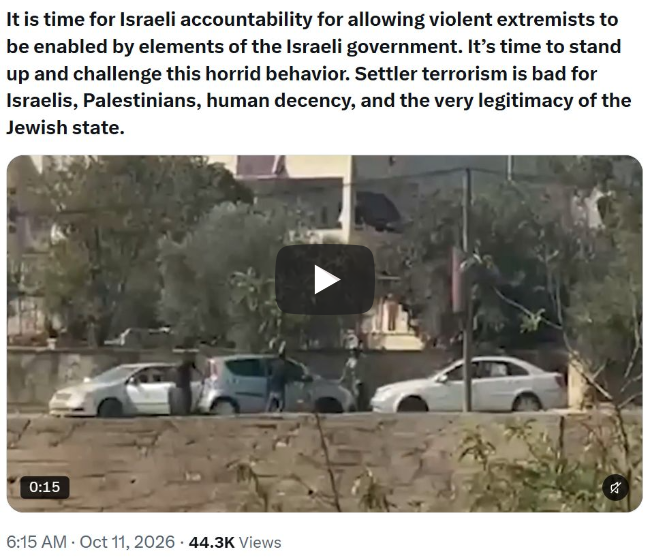
| The post above comes from an Arab Muslim from Gaza; the essay excerpted below was also published today by an Arab Muslim from Egypt. You won’t find anyone in the West speaking with more lucidity and moral clarity about Israel than these two:
The violence and lawlessness in the West Bank are a greater threat to Israel than many Israelis are willing to believe…
To put it plainly: the problem, though no doubt aggravated by the terrorist massacres of October 7, was growing long before them. In February 2023, hours after a Palestinian gunman murdered two Israeli brothers, Hallel and Yagel Yaniv, near the Palestinian village of Huwara, hundreds of radical Israelis descended on the village, setting homes and cars ablaze; a Palestinian man was killed, and the IDF’s commander for the West Bank, Major General Yehuda Fox, called it a pogrom. Days later, Finance Minister Bezalel Smotrich declared, “I think the village of Huwara needs to be wiped out. I think the State of Israel should do it.”
I do not wish to regurgitate the catalog of such violent incidents. The anti-Israel press corps keeps meticulous records of them, and adds a few of its own for good measure. We are all familiar with them; the reader gets the picture.
Understandably, things only grew worse after October 7, once Israelis had watched the videos, many of them filmed by the terrorists themselves on body cameras and phones, of Hamas men beheading and murdering men, women, and children in southern Israel. To expect broad sympathy for the Palestinians after that, or even concern for their condition, would be cruel and inhumane. Yet anger often drifted into rage, understandable but still dangerous and condemnable, and it found expression in incriminating statements. For instance, one Israeli official, from the new right, declared on Israeli radio that there were no innocent people in Gaza; when asked whether dropping a nuclear bomb on the Strip was an option, he replied that it was “one of the possibilities.”
So reckless were such statements that, to his credit, Prime Minister Netanyahu immediately suspended him from cabinet meetings. The claim that there are no innocents in Gaza is, first of all, categorically false: there are many innocents in Gaza, beginning with its infants. It is, moreover, irresponsible in Israel’s security situation, and not as a matter of manners. South Africa’s genocide application to the International Court of Justice quoted statements of exactly this kind as evidence of intent, and the court’s provisional order of January 2024 cited several of them, so that the rage of a few officials became an exhibit in the very libel Israel has spent three years refuting. Finally, such statements make Israel’s position harder both in the region, at a moment when more Arabs are open to Israel than ever before, and in the world, at a moment of rising hatred and conspiracy theories about the Jewish state…
In Genesis, a book you should definitely be reading more, when Simeon and Levi put Shechem to the sword—Shechem is today’s Nablus, coincidentally a few miles up the road from today’s Huwara—Jacob, by then already converted into Israel after he had abandoned his crooked ways, did not praise their zeal. “Ye have troubled me,” he told them, “to make me to stink among the inhabitants of the land.”
And yet there are also those who read and believe the Bible standing firmly on the side of the current government in Israel, including the Jewish writer Michael Freund, who this weekend credits the same minister Smotrich cited above with leading a revolution in Israel’s settlement policy:
…for those of us who believe that establishing a hostile Palestinian terrorist state in Israel’s biblical heartland would be a historic and strategic disaster, it is precisely why the revolution matters.
Smotrich has not merely changed settlement policy.
He has changed the map, making a Palestinian state in Judea and Samaria virtually impossible.
And thank God for that.
(Incidentally, not a few Palestinians themselves would agree they don’t want to live in a Palestinian state, as they’ve lost faith in their current political movements).
It was also concerning this week to see the leading candidate among Israel’s opposition parties, Gadi Eisenkot, specifically and repeatedly come out against the blessing spoken over Israel in the Torah by the prophet Balaam:
If, God forbid, the current right-wing coalition wins again, it will lead Israel in dark directions that we can already see unfolding before us: a less democratic, less liberal country, and in my view, also a less Jewish one.
Anyone who wants to impose full sovereignty over all of Judea and Samaria [the West Bank] and bring another 2.8 million Palestinians into Israel is endangering the Zionist enterprise and the Jewish demographic majority. Anyone who wants to weaken the Supreme Court and crush the judiciary is endangering democracy.
So this election is fundamentally about the future of the State of Israel. That is what drives me from morning to night to do everything I can to win, and to not allow Netanyahu and his coalition to build a state based on the concept of “a people that dwells alone.”
…The first thing is a fundamental change in Israeli policy: Israel is not “a people that dwells alone.” It is a vital part of the community of nations.
Hmmm. The uniqueness and singularity of the Jewish people, “a people that dwells alone,” is the very promise of the Bible. Is it wise to deliberately oppose God?
And while Eisenkot promises to put an end to the anarchy in the West Bank, he would do so by dismantling the work of Smotrich, and yielding the very heartland to which the prophet Ezekiel says the people of Israel will be finally regathered. As people for whom the word of God is the light of our life, this too is troubling.
Is it right to judge political issues by what the Bible says? No little controversy was stirred up in Jerusalem this week by a small conference of American nationalists, who came to explain to the Jewish people why they should no longer count on US Christians to be their allies: |